Overview
Things to Know
What Makes Imperial City Special
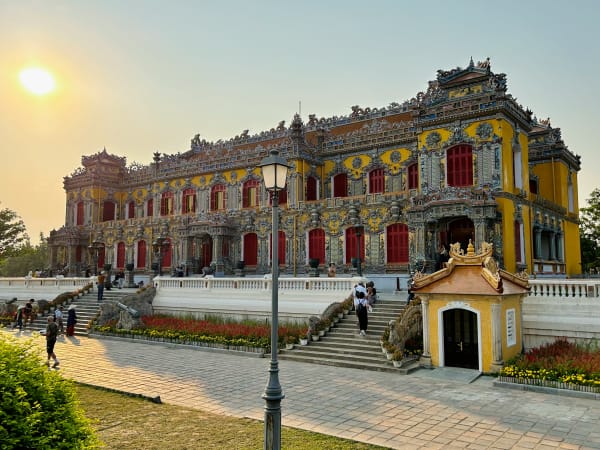
Huế's Imperial City - Đại Nội - was built between 1804 and 1833 under Emperor Gia Long, the founder of the Nguyễn Dynasty, and served as the political, cultural, and spiritual centre of Vietnam until 1945 when Emperor Bảo Đại abdicated and the dynasty ended. The complex follows the same cosmological principles as Beijing's Forbidden City - oriented to face south, surrounded by a moat, organised around an axis of increasingly sacred spaces from the outer citadel to the Forbidden Purple City at the centre. At its peak, the Imperial City contained over 140 buildings across 3 square kilometres. The 1968 Tết Offensive reduced large sections to rubble, and decades of neglect after reunification left much of the remainder in decay. UNESCO recognition in 1993 triggered a restoration programme that continues today - roughly half the complex has been rebuilt or stabilised, making Đại Nội simultaneously a grand imperial monument and an honest record of war's destruction.
Gallery



How to Get There
🚗 Getting There
The Imperial City is in the centre of Huế, on the north bank of the Perfume River - about 1km from the main tourist hotel district on the south bank. It's walkable from most central hotels (15–20 minutes), easily reached by bicycle, xe ôm, or Grab. The main entrance is through Ngọ Môn Gate on the south facade. Parking is available outside the gate for motorbikes and cars. Most travellers combine the Imperial City with an afternoon on the south bank - the Perfume River separates the two halves of Huế's historic geography.
What to Expect
👀 On the Ground
The visit begins at Ngọ Môn Gate - the ceremonial southern entrance with a viewing terrace from which emperors watched festivals below. Inside, the Esplanade of the Great Salutation leads to Điện Thái Hòa (Palace of Supreme Harmony), the most intact and most photographed building in the complex, with its red lacquer columns, gilded throne, and ornate roof. Beyond lies the Forbidden Purple City - the emperor's private residence, now mostly open foundations and a few restored pavilions. The east and west wings contain temples, libraries, theatres, and gardens in various states of restoration. The northeast section, heavily damaged in 1968, preserves the ruins as they stand - roofless walls, overgrown foundations, scattered tiles.
Travel Tips
🧳 Tips
The Imperial City requires at least 2–3 hours to cover properly - rushing it in 90 minutes leaves half the complex unseen. Hire an audio guide at the entrance (available in English, French, Japanese) or join a guided tour to get context for the buildings, as many are unmarked or labelled only in Vietnamese. The combination of the Imperial City, Thiên Mụ Pagoda, and one royal tomb - either Khải Định or Tự Đức - is the standard Huế full-day itinerary and genuinely covers the city's three most historically significant sites.
Insider Tips
Based on real traveler experiences and commonly mentioned advice from multiple visitors.
FAQ
Common questions from travelers who've visited this place.
How long should I spend at the Imperial City?›
What's the best time to visit?›
What payment methods are accepted?›
Nearby Locations
Explore more things to do like this around Vietnam