Overview
Things to Know
What Makes Khải Định Tomb Special
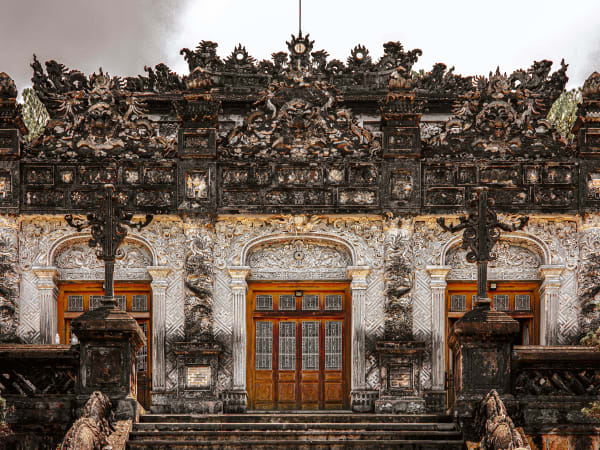
Khải Định was the 12th emperor of the Nguyễn Dynasty, ruling from 1916 to 1925 under French protectorate conditions that left him with ceremonial power and little else. He spent 11 years and a significant portion of the royal treasury - funded partly by a 30% tax increase on his subjects - building a mausoleum that reflected his singular aesthetic vision: a fusion of Vietnamese imperial tradition, French Baroque, Gothic, and Hindu architectural elements, clad in dark reinforced concrete and crowned with iron dragons, set on a hillside 10km south of Huế. Inside, the Khải Thành Palace contains the most elaborate interior of any Vietnamese royal tomb - every surface covered in mosaic made from fragments of porcelain, glass, and ceramic, assembled by artisans into dragons, phoenixes, clouds, and celestial scenes. A bronze effigy of the emperor sits above the actual burial chamber. The tomb was controversial in its time - critics saw it as a symbol of collaboration with the French - and remains architecturally unique in Vietnam.
Gallery



How to Get There
🚗 Getting There
Khải Định Tomb is 10km south of central Huế, on a forested hillside in Châu Chữ village. From central Huế, the most common approach is by motorbike or bicycle along Highway 49 (about 25–30 minutes). Grab and xe ôm are also available. Most travellers visit Khải Định as part of a royal tombs circuit that also includes Tự Đức Tomb (4km further southwest) and sometimes Minh Mạng Tomb. All three are within a 15km radius of central Huế and can be covered in a single day by motorbike.
What to Expect
👀 On the Ground
The tomb rises in terraces up the hillside - 127 steep steps divided into five platforms, each flanked by stone mandarins, elephants, and horses standing at attention. The climb is part of the experience; each platform reveals more of the dark facade above. The Khải Thành Palace at the summit is the burial chamber and the visual centrepiece: a single large room where floor, walls, and ceiling are entirely covered in mosaic assembled from broken porcelain and coloured glass imported from China, France, and Japan. The detail is extraordinary at close range - patterns shift from geometric to figurative to calligraphic. The bronze statue of Khải Định sits on a dais above the sealed burial vault. The surrounding hillside has gardens and smaller pavilions.
Travel Tips
🧳 Tips
Of Huế's seven royal tombs, Khải Định is the most dramatic visually and the most compact geographically - a good choice if you only have time for one tomb. Tự Đức Tomb is the alternative recommendation: larger, more garden-oriented, and more traditionally Vietnamese in feel. The two complement each other well and can be visited back-to-back in an afternoon. Minh Mạng Tomb is the most architecturally grand but requires more time. For first-time visitors to Huế with one day, the standard itinerary - Imperial City in the morning, Thiên Mụ Pagoda midday, Khải Định Tomb in the afternoon - covers the three most visually distinctive sites in the city.
Insider Tips
Based on real traveler experiences and commonly mentioned advice from multiple visitors.
FAQ
Common questions from travelers who've visited this place.
How much does it cost and what are the hours?›
Is the staircase difficult to climb?›
How long does a typical visit take?›
Nearby Locations
Explore more things to do like this around Vietnam