Overview
Things to Know
What Makes Angel Eye Mountain (God Eye Mountain) Special
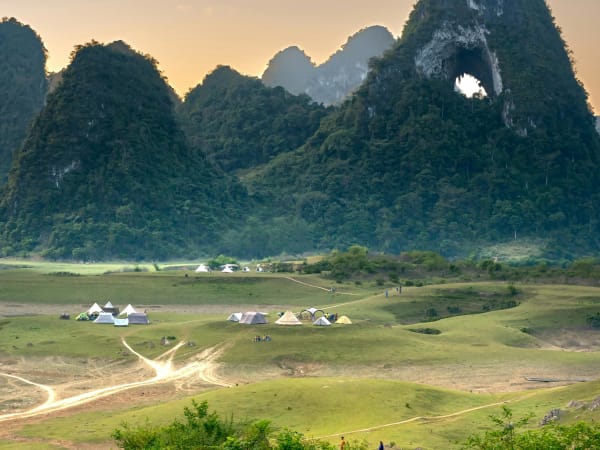
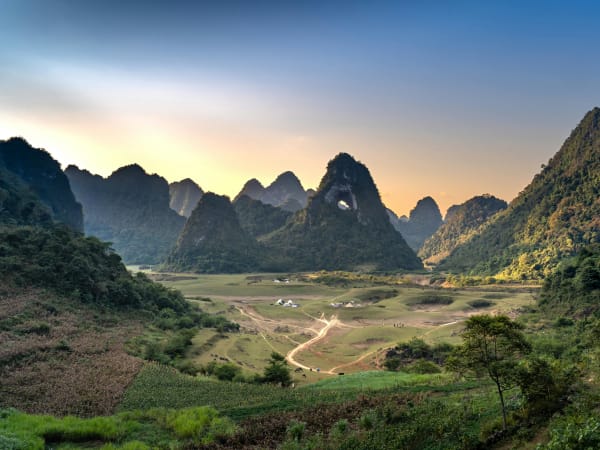
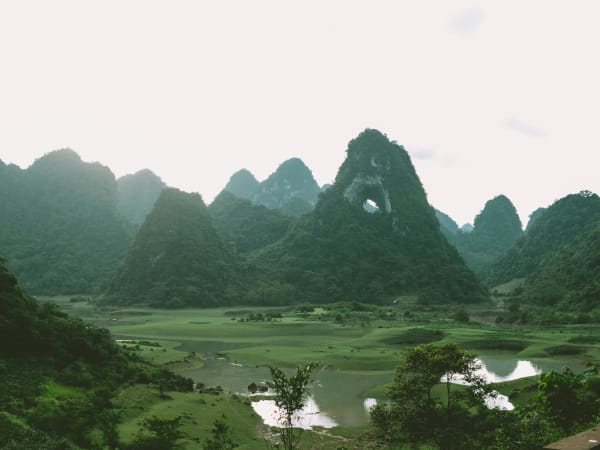
Angel Eye Mountain (Núi Mắt Thần, also written as Núi Thủng - 'the mountain with a hole through it') is a limestone karst peak in Trùng Khánh district of Cao Bằng province, part of the Non Nước Cao Bằng UNESCO Global Geopark. Its defining feature is a naturally formed circular cave approximately 50 meters in diameter that passes completely through the upper section of the mountain, creating an opening that resembles a giant eye when viewed from the valley floor. The cave formed over 300 million years ago and was lifted to its current elevation by tectonic activity. The mountain sits in the Thang Hen valley system - a karst landscape of cone-shaped limestone towers interspersed with more than 30 interconnected lakes at 650-700m elevation. Each year from June to August, rainfall fills the valley floor into a single lake of around 15 hectares, and the mountain rises directly from the water. By September the lake drains underground and the valley returns to meadow. In Tày language the mountain is called Phja Piot - the mountain with a hole.
Gallery

How to Get There
🚗 Getting There
Angel Eye Mountain is approximately 30-50km from Cao Bằng city, in Cao Chương commune, Trùng Khánh district. From Cao Bằng city, head north on National Highway 3, ascend the Ma Phục Pass, then turn left toward Trà Lĩnh and Thang Hen Lake rather than continuing straight to Bản Giốc. From Thang Hen Lake, the mountain is a further 7km to Bản Danh hamlet - follow the track to the valley floor, park vehicles, and walk the final 1.5 - 3km on foot through rice paddies to the mountain base. The total journey from Cao Bằng city takes about 1.5 - 2 hours by motorbike. The site is a natural add-on to the standard Cao Bằng loop that includes Bản Giốc Waterfall and Ngườm Ngao Cave.
What to Expect
👀 On the Ground
The valley approach on foot passes through rice paddies and along stone paths with the mountain visible ahead - the circular hole is visible from the valley floor and becomes more dramatic as you get closer. At the base, a short climb of about 45 minutes reaches the cave itself, which is roughly 50m wide, 45m high, and nearly 100m long - a through-going arch rather than a blind cave. Inside, iron trees grow from the limestone floor and walls. Looking through the arch in each direction gives framed views of the valley and distant mountain ranges. In the rainy season, the walk is replaced by a raft crossing and the mountain rises directly from the lake surface. The flat valley meadow in the dry season is suitable for camping and has space for tents well away from the mountain base.
Travel Tips
🧳 Tips
Angel Eye Mountain is one of those geological features that photographs poorly relative to how it feels in person - the 50m hole in a limestone cliff is genuinely extraordinary at close range in a way that no image fully conveys. It sits on the Cao Bằng loop that most riders do for Bản Giốc, but is frequently skipped because it requires a detour through Thang Hen rather than the direct highway. That detour is short and the valley - with its interconnected lakes, karst towers, and meadow floor - is itself worth the deviation. The combination of Thang Hen Lake, Angel Eye Mountain, and Ma Phục Pass covers a section of Cao Bằng that most visitors miss entirely and is arguably as interesting as the more famous Bản Giốc end of the loop.
Insider Tips
Based on real traveler experiences and commonly mentioned advice from multiple visitors.
FAQ
Common questions from travelers who've visited this place.
Is there water and a lake when I visit?›
Can I reach the mountain by motorbike or do I need to walk?›
Is it crowded and do I need to buy tickets?›
Nearby Locations
Explore more things to do like this around Vietnam