Overview
Things to Know
What Makes Ban Gioc Waterfall Special
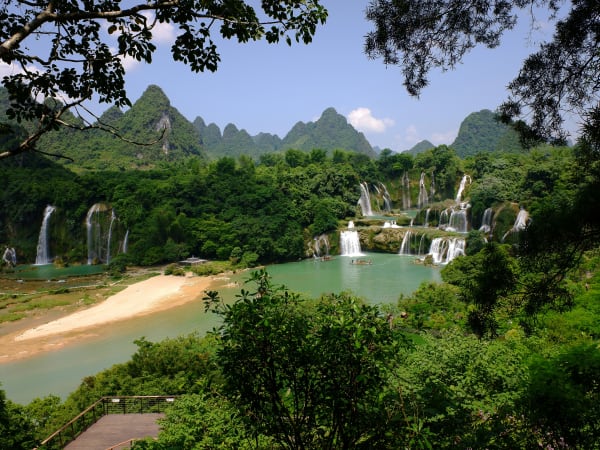
Bản Giốc sits on the Quây Sơn River at the Vietnam-China border, 90km north of Cao Bằng city, and is the largest waterfall in Southeast Asia by width. The falls spread across 300 metres in three distinct tiers, dropping 30 metres into a wide turquoise pool before the river continues south into Vietnam. The border runs down the middle of the water - the right section belongs to Vietnam, the left to China - which makes Bản Giốc one of the few places in the world where you can watch a waterfall and see another country simultaneously. In September and October, after the monsoon, the Quây Sơn swells and the falls merge into a single roaring curtain of white water. In dry season, the tiers separate and the individual cascades become more defined. Either way, the scale - framed by karst mountains on both sides and rice terraces on the Vietnamese bank - is unlike anything else in northern Vietnam.
Gallery



How to Get There
🚗 Getting There
Bản Giốc is 90km north of Cao Bằng city, along a mountain road that takes approximately 2.5–3 hours by motorbike. The road is scenic but demanding - winding, narrow in sections, and with occasional rough patches after rain. Most independent travellers ride from Cao Bằng city, either on their own motorbike or renting one in town. Guided motorbike tours from Cao Bằng are available and recommended for less experienced riders. There is no direct bus to the falls. The nearest accommodation is in Trùng Khánh town, 20km south, or guesthouses in Đàm Thủy village immediately beside the falls.
What to Expect
👀 On the Ground
The main viewpoint is a grassy riverbank with direct sight lines to the full width of the falls. Bamboo raft operators at the dock take visitors across the river and to the base of the falls - the 15-minute ride gets you close enough to feel the spray and hear the full roar of the water. The pool at the base is a vivid jade-green from the minerals suspended in the water. On the Vietnamese bank, rice terraces rise behind the viewing area and the karst mountains frame the falls on both sides. On busy days, Chinese tourists on the opposite bank are visible on their own viewing platforms. The area around the falls has a small village with food stalls and guesthouses.
Travel Tips
🧳 Tips
Bản Giốc is the centrepiece of Cao Bằng province - worth the long journey from Hanoi specifically. The standard itinerary pairs it with Nguồm Ngao Cave (3km away) and Phong Nam Valley (on the road back toward Cao Bằng city) into a single day or two-day loop. Staying overnight in Đàm Thủy village gives access to the falls at sunrise, before any other visitors arrive - the light on the water in early morning, with mist rising off the pool, is the best the falls ever look.
Insider Tips
Based on real traveler experiences and commonly mentioned advice from multiple visitors.
FAQ
Common questions from travelers who've visited this place.
What is the best time to visit to avoid crowds?›
Is the bamboo raft ride necessary?›
What are the road conditions and travel time from Hanoi?›
Nearby Locations
Explore more things to do like this around Vietnam