Overview
Things to Know
What Makes Cao Đài Holy See Special
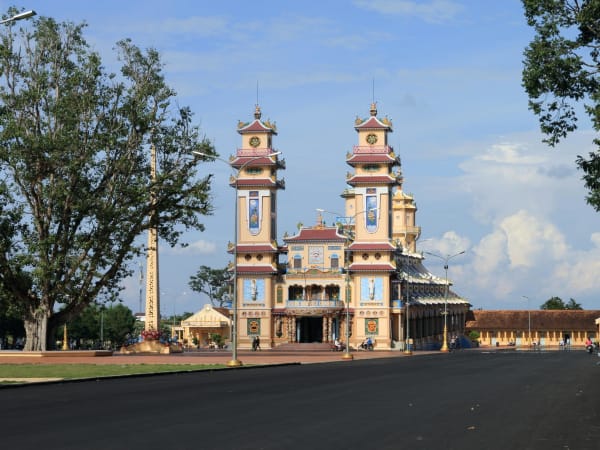
Caodaism (Đạo Cao Đài) is a syncretic Vietnamese religion founded in Tây Ninh in 1926, combining elements of Buddhism, Taoism, Confucianism, and Christianity into a single doctrine - with a pantheon that includes the Buddha, Laozi, Confucius, Jesus Christ, and, improbably, the French writer Victor Hugo (who appeared in séances as a spiritual guide). The Cao Đài Holy See is the religion's world headquarters, built between 1933 and 1955, and its Great Divine Temple is one of the most visually remarkable buildings in Vietnam. The architecture is a controlled explosion of color and eclecticism: pink and yellow towers topped with divine eyes, a nave ceiling painted to resemble a blue sky with clouds, and columns entwined with dragons supporting a structure that reads simultaneously as cathedral, pagoda, and fever dream. Caodaism has approximately 3–4 million followers, primarily in southern Vietnam.
Gallery



How to Get There
🚗 Getting There
The Cao Đài Holy See is in Tây Ninh town, approximately 96km northwest of Ho Chi Minh City - a journey of 1.5–2 hours by car via National Highway 22. Day tours from HCMC are abundant and the most convenient option for most visitors, typically combining the Holy See with a visit to Củ Chi Tunnels on the same day. Independent travelers can take a bus from HCMC's Tây Ninh bus terminal (Mỹ Đình-style departures from An Sương or Củ Chi direction) or rent a motorbike for the day.
What to Expect
👀 On the Ground
The compound is large and the main cathedral is accessible before and after ceremonies. During the ceremony itself, several thousand robed worshippers fill the nave in precise formation - white-robed laypeople, blue-robed Buddhists, red-robed Taoists, and yellow-robed Confucianists moving in choreographed ritual while a choir performs from an elevated platform. The effect is unlike anything else in Vietnam - visually dense, sonically layered, and conducted with genuine devotion rather than performance for visitors. After the ceremony, the grounds are open to explore freely.
Travel Tips
🧳 Tips
The Cao Đài Holy See is genuinely one of the most singular places in Vietnam - there is nothing else like it in the country or, arguably, in the world. The combination of the architecture, the theology, and the ceremony creates an experience that is difficult to categorize and impossible to forget. The noon ceremony is the right one for day-trippers: long enough to be complete, accessible without a very early start from HCMC. If mày is based in Hồ Chí Minh City and has one day for a regional day trip, the Holy See beats the standard Củ Chi-only itinerary. Combine both in the same day - Củ Chi in the morning, Tây Ninh in the afternoon - and mày have a genuinely full picture of what the south has on offer beyond the city.
Insider Tips
Based on real traveler experiences and commonly mentioned advice from multiple visitors.
FAQ
Common questions from travelers who've visited this place.
What are the dress code requirements?›
When should I visit to see prayer ceremonies?›
Are there any hazards in the complex?›
Nearby Locations
Explore more things to do like this around Vietnam