Overview
Things to Know
What Makes Quản Bạ Twin Mountains Special
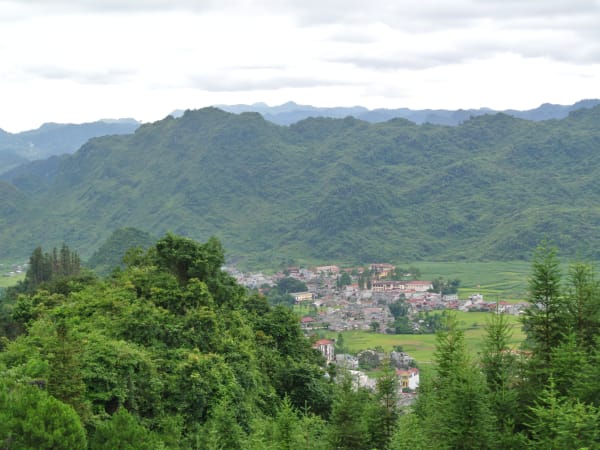
The Twin Mountains - Núi Đôi - are two near-identical limestone peaks rising approximately 400 metres from the Quản Bạ Valley floor, side by side, their symmetry so precise that they appear deliberately placed. The peaks are the visual centrepiece of the Quản Bạ section of the Ha Giang Loop and appear in more photographs of the route than almost any other single landmark. The Tày people's legend explains the mountains as the petrified bodies of twin infants left behind by a celestial fairy who was summoned back to heaven by the Jade Emperor - she left her children in the valley, and they became mountains waiting for her return. The peaks are surrounded by rice terraces worked by H'mong and Tày minority families, and the combination of the geometric mountain forms rising from the layered green and gold terraces is one of the most compositionally distinctive landscapes in northern Vietnam.
Gallery



How to Get There
🚗 Getting There
The Twin Mountains are in the Quản Bạ Valley, visible from the Heaven Gate descent road 46km north of Hà Giang city. The main viewpoints are along the descent road from Heaven Gate (the peaks are visible for the entire 10km descent) and from the hillside above Quản Bạ town. The valley floor around the peaks is accessible by motorbike on a side road from Quản Bạ town - riding the loop of roads around the mountains gives ground-level views of the surrounding rice terraces. The town of Quản Bạ is the nearest accommodation base.
What to Expect
👀 On the Ground
From the Heaven Gate descent road, both peaks are visible simultaneously against the valley backdrop. The view changes continuously as the road switchbacks down - different angles, different distances, different proportions of terrace and mountain and sky. From the valley floor, the peaks are massive and close - the scale only apparent when standing beneath them. The trail to the base of the northern peak begins from a signposted path in Quản Bạ town and takes about 40 minutes to reach the lower slopes. The surrounding terrace roads are excellent for slow motorbike riding or walking - the farms and villages around the mountains are active and unhurried.
Travel Tips
🧳 Tips
Núi Đôi is a photograph destination first and a trekking destination second - the views of the peaks from the descent road and the hillside above town are the primary draw. Allow at least 30–45 minutes in the Quản Bạ area for the mountains specifically - the descent road offers multiple stopping points and the views change enough to justify pausing at two or three spots. In cloud inversion conditions (dawn in October–November), the peaks above the mist are one of the most exceptional natural photographs available on the loop.
Insider Tips
Based on real traveler experiences and commonly mentioned advice from multiple visitors.
FAQ
Common questions from travelers who've visited this place.
When is the best time to visit for clear views?›
How difficult is the climb to the viewpoint?›
What facilities are available at the site?›
Nearby Locations
Explore more things to do like this around Vietnam