Overview
Things to Know
What Makes Hội An Ancient Town Special
Hội An Ancient Town is the most intact historic trading port in Southeast Asia - a 30-block district of 1,000-year-old merchant houses, Chinese assembly halls, Japanese-built bridges, French colonial facades, and Vietnamese tube houses compressed along the north bank of the Thu Bồn River. The town reached its peak as a trading port in the 16th and 17th centuries, when Japanese, Chinese, Portuguese, Dutch, and later French merchants maintained quarters here, each community leaving architectural traces. UNESCO World Heritage inscription in 1999 recognised the exceptional preservation of the urban fabric - Hội An avoided the bombing that destroyed most Vietnamese cities during the wars, and the subsequent decades of poverty meant no modernisation redevelopment. The result is a historic district where the original street layout, building scale, and architectural language survive almost intact. Today it's one of Vietnam's most visited destinations, a fact that brings both vitality and challenge - the Old Town's atmospheric lantern-lit evenings can feel genuinely magical or genuinely overcrowded depending on timing.
Gallery



How to Get There
🚗 Getting There
Hội An is 30km south of Đà Nẵng city and 30km from Đà Nẵng International Airport. The most common approach is taxi or Grab from Đà Nẵng (40–50 minutes, around 300,000–400,000 VND). There is no train station in Hội An - the nearest is Đà Nẵng. Express buses run from Đà Nẵng's bus station to Hội An (about 1 hour, 50,000 VND). From further afield, most travellers take the train or fly to Đà Nẵng and transfer. Within Hội An, the Old Town is best explored on foot - it's compact, flat, and most of the key sites are within a 15-minute walk of each other.
What to Expect
👀 On the Ground
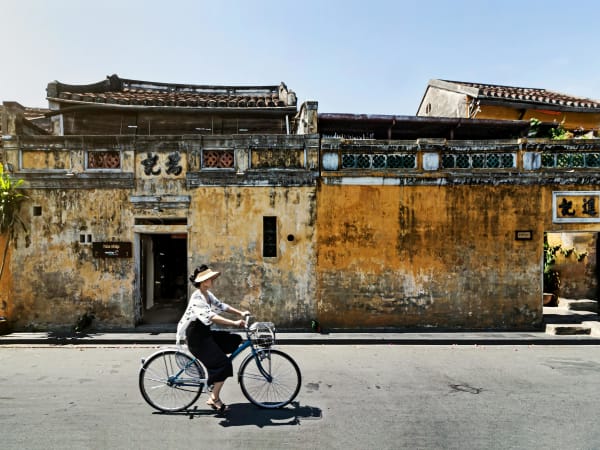
The Ancient Town is organised around Trần Phú Street - the main east-west axis - and the riverfront Bạch Đằng Street. The key heritage buildings include the Japanese Covered Bridge (Chùa Cầu) at the western end, the Tấn Ký Ancient House and Phùng Hưng House on Nguyễn Thái Học, the Phúc Kiến Assembly Hall on Trần Phú, and the central market near the river. The streets between are lined with yellow-walled shophouses selling silk, lanterns, tailored clothing, lacquerware, and art. The Thu Bồn riverfront has cafes and restaurants with views across to the coconut-palm-lined opposite bank. On the 14th of each lunar month, the Lantern Festival transforms the streets - all electric lights off, lanterns everywhere, boats on the river.
Travel Tips
🧳 Tips
Hội An rewards slow travel more than almost anywhere in Vietnam. One full day gives you the landmarks; two or three days lets you find the less-visited streets, eat your way through the food stalls, cycle to Trà Quế and An Bàng Beach, and experience the town at different times of day. The crowds are real - Trần Phú Street at 11 AM in peak season is shoulder-to-shoulder - but the town is large enough that the quieter streets and early morning hours remain genuinely pleasant. Stay at least one night to experience the Lantern Festival evening or simply the way the town feels after 9 PM when the day-trippers from Đà Nẵng have left.
Insider Tips
Based on real traveler experiences and commonly mentioned advice from multiple visitors.
FAQ
Common questions from travelers who've visited this place.
When is the best time to visit Hoi An?›
How long should I spend in Hoi An?›
Is tailoring in Hoi An reliable?›
Nearby Locations
Explore more things to do like this around Vietnam