Vietnam surprises first-time visitors. You land expecting chaos and find something that feels - almost immediately - manageable. Streets humming with motorbikes, strangers offering directions without being asked, street food stalls lit until midnight. Many solo travelers say the same thing a week in: "Why was I worried?"
But that comfort can make you careless. And careless is exactly what the taxi driver running an unofficial meter, or the "friendly local" steering you toward a commission-paying restaurant, is counting on.
More than 21 million international visitors traveled to Vietnam in 2025 - and the overwhelming majority experienced no serious safety problems. This guide explains why, and what the minority of cases looked like.
Quick verdict:
- ✅ Violent crime against tourists is very rare. Vietnam ranks #38 globally on the 2025 Global Peace Index - among the safer countries in Southeast Asia.
- 💰 Most "danger" in Vietnam is financial, not physical. Scams target your wallet, not your body - and typical losses are $5–$30, not injuries.
- 🚗 Traffic is the real risk. Road accidents cause far more tourist deaths than crime. Urban traffic in Hanoi and Ho Chi Minh City is genuinely dangerous by international standards.
- 🌾 Rural Vietnam is consistently safer from crime than cities - though rural roads and limited medical access introduce different risks.
How Vietnam Compares: The Data
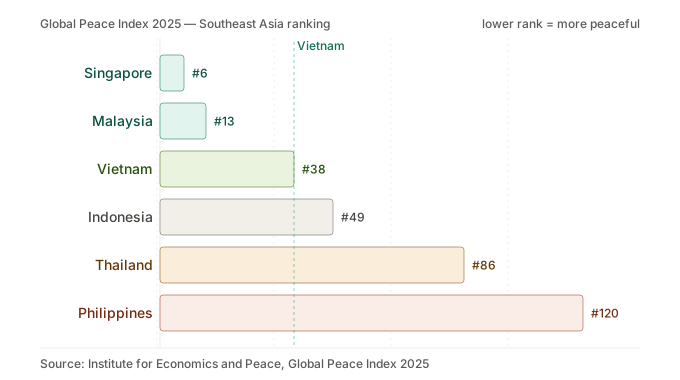
First, the macro picture. Vietnam's position in Southeast Asia is strong by international safety metrics - and the gap with its neighbors is larger than most guides acknowledge.
| Country | GPI Global Rank (2025) | Crime vs Tourists | Solo Travel Safety |
|---|---|---|---|
| Singapore | #6 | Very low | Very safe |
| Malaysia | #13 | Low | Very safe |
| Vietnam | #38 | Low (petty only) | Safe |
| Indonesia | #49 | Low–Moderate | Safe |
| Thailand | #86 | Moderate | Some awareness needed |
| Philippines | #120 | Higher | Caution needed |
Source: Global Peace Index 2025, Institute for Economics and Peace. Ranks 163 countries across 23 indicators including violent crime, civil unrest, and political instability.
Vietnam at #38 sits 48 places ahead of Thailand and 82 ahead of the Philippines. That's a meaningful difference, not a rounding error.
It's also worth noting what GPI measures: societal safety, political stability, and conflict levels - not tourist-specific scam exposure, which is a separate category where vigilance is still warranted.
Key numbers at a glance:
- #38 - Vietnam's Global Peace Index rank (2025) out of 163 countries
- #86 - Thailand's GPI rank - 48 places behind Vietnam
- ~2 - Intentional homicides per 100,000 people - well below the global average
The Real Risk #1: Scams - And What They Actually Cost
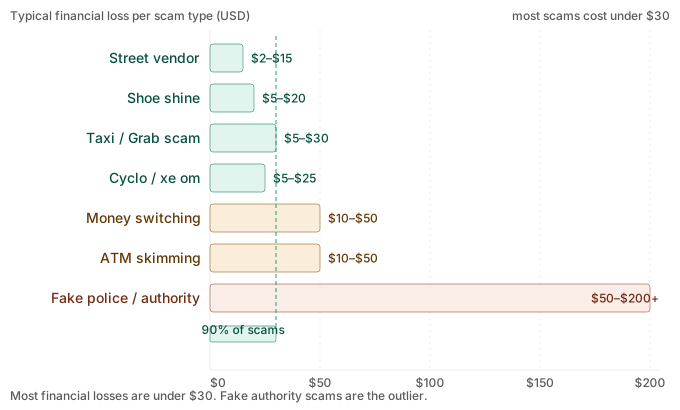
This is the most common problem tourists encounter in Vietnam. Understanding it correctly changes how you travel: the vast majority of Vietnam scams are financial, not physical. A Vietnam scam is almost never a mugging - it's a driver who "forgets" to run the meter, a vendor charging tourist prices, or a shoe-shiner who starts polishing before you can say no.
Many travelers arrive with generalized fear of "danger" when what they actually face is the risk of overpaying by a few dollars. That's worth knowing - both for perspective and to avoid the other mistake: letting comfort make you stop paying attention.
What Scams Typically Cost
No official aggregate data exists on average scam losses, but based on documented cases across traveler forums and embassy advisories, here's a realistic range:
| Scam Type | Typical Loss | Context |
|---|---|---|
| Taxi meter / unmetered ride | $5 – $30 | Airport routes most common |
| Shoe shine scam | $5 – $20 | Demand escalates with pressure |
| Street vendor overpricing | $2 – $15 | Fruit, coconuts, small snacks |
| Cyclo / xe ôm overcharge | $5 – $25 | No agreed price before boarding |
| Commission restaurant redirect | 20–50% meal markup | Driver "recommends" partner spot |
| Money switching | $10 – $50 | Swaps correct change for wrong notes |
| Fake police / authority | $50 – $200+ | Highest pressure, least common |
The pattern is clear: most tourist scams result in losses under $30. Fake authority scams are the outlier - rarer, but they rely on psychological pressure rather than price confusion and can extract significantly more.
The key insight: Vietnam's scam landscape is best understood as an opportunistic pricing problem, not a safety problem. Locals are generally not trying to harm you - they're trying to capture extra dollars from visitors who don't know local prices. Knowing prices, using Grab, and being willing to walk away resolves the vast majority of situations before they escalate.
👉 Going deeper on scams? We've documented 25 specific Vietnam tourist scams - with real examples and exactly how to avoid each one. Read: Common Scams in Vietnam (Real Stories & How to Avoid Them) →
The Real Risk #2: How Tourists Actually Die in Vietnam
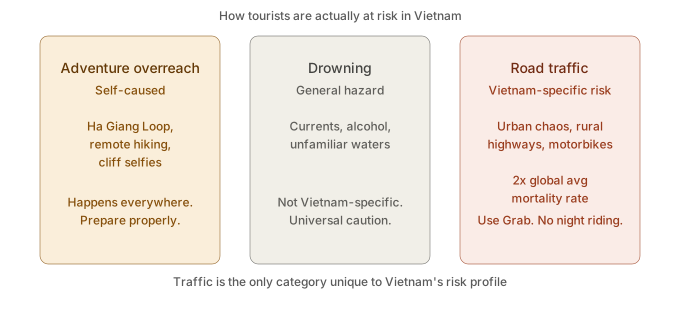
Most safety guides bury this. Let's be direct about what the actual risk profile looks like - broken into the three distinct categories that account for tourist deaths in Vietnam.
🟡 Self-caused: Adventure overreach & poor preparation
Getting lost hiking without a guide in remote terrain (Ha Giang, Sapa). Taking on the Ha Giang Loop without real motorbike experience. Swimming in unmarked or dangerous ocean areas.
A Spanish tourist died in 2017 after losing control of a motorbike on a mountain pass. A British tourist was seriously injured in 2023 taking a selfie on a cliff edge. These are tragic accidents - but identical types occur in New Zealand, Switzerland, and Canada. The Vietnam-specific factor is that inexperienced travelers frequently underestimate terrain difficulty, often because no one stopped them from renting a motorbike.
⚪ General: Drowning & water accidents
Drowning is one of the leading causes of tourist death globally, and Vietnam is no exception. Unfamiliar ocean currents, overestimating swimming ability, alcohol near water - these risks exist wherever there's coastline. They are not Vietnam-specific.
🔴 Traffic: The genuine Vietnam-specific risk
This is where Vietnam's safety picture differs from countries like Japan or Singapore.
According to U.S. government data (CDC), 16 American citizens died in traffic accidents in Vietnam over a three-year period (2019–2021) - placing Vietnam in the top four countries globally for American tourist road deaths. Vietnam's road traffic mortality rate is roughly double the global average.
The causes are well-documented: chaotic urban traffic, poor road conditions outside cities, mixed vehicle types sharing roads, inadequate enforcement, and tourists on motorbikes in conditions they're not prepared for.
⚠️ Honest assessment of Vietnam's traffic: Vietnam's traffic problems are real and acknowledged - not exaggerated. They are concentrated in Ho Chi Minh City, Hanoi, and on national highways. Using Grab in cities, avoiding motorbike rental without genuine riding experience, and never riding at night on unfamiliar rural roads eliminates the majority of this risk.
Traffic accidents happen everywhere. The question is relative risk. Vietnam's urban traffic and highway network carries higher risk than comparable roads in Western countries - not from malice, but from infrastructure gaps, enforcement gaps, and a motorbike-dominated culture that operates on informal rules most foreign visitors have never navigated before.
Urban vs Rural: Two Very Different Safety Profiles
One of the most consistent findings across traveler accounts and government advisories is that Vietnam's safety landscape isn't uniform. The urban/rural split is significant enough to address directly.
Major cities (HCMC, Hanoi, Da Nang, Nha Trang):
- Highest concentration of tourist scams
- Motorbike bag-snatching - most common near Bến Thành, Old Quarter, Bùi Viện
- Pickpocketing in crowded markets and festival areas
- Chaotic traffic - highest pedestrian and rider risk
- Incidents spike during Tết and major holidays
- More fake authority / police scams than rural areas
Rural areas, villages & countryside:
- Consistently lower crime rates than urban centers
- Communities widely described as welcoming and hospitable
- Tourist scams far rarer - fewer opportunities, different culture
- Violent crime against tourists is extremely uncommon
- Risk shifts to: road conditions, mountain terrain, no lighting at night
- Medical facilities sparse - evacuation insurance matters more here
Rural Vietnam - the Mekong Delta, mountain villages of Sapa and Ha Giang, coastal fishing communities - is where the cultural generosity that defines Vietnam as a travel destination is most visible. Multiple sources, including government travel advisories and long-term traveler accounts, consistently describe village communities as low-crime environments where foreign visitors are treated with genuine curiosity rather than commercial intent.
The rural nuance: Rural Vietnam is safer from crime. But the risk profile changes rather than disappears. Mountain roads with no guardrails, difficult river crossings, venomous snakes in jungle areas, and limited emergency services create different hazards - particularly for motorbike travelers on remote routes. Travel insurance with medical evacuation coverage is significantly more important if you're going deep into the countryside.
Is Vietnam Safe for Solo Female Travelers?
Yes - and this is one area where Vietnam genuinely outperforms much of the region. Serious harassment of solo female travelers is uncommon. Vietnam doesn't share the street harassment culture of parts of South Asia or South America. Multiple long-term female solo travelers consistently rank it among their most comfortable destinations in Southeast Asia.
- 👗 In rural areas and at temples, dress conservatively - shoulders and knees covered. Not legally required, but reduces unwanted attention in conservative communities.
- 🌙 Avoid walking alone on poorly lit streets late at night in cities. Use Grab after dark - it's inexpensive and eliminates most late-night risk.
- 🏨 Stick to established guesthouses and hostels in tourist zones - staff are experienced with foreign guests and tend to look out for them.
- 📱 Trust your instincts. Vietnamese culture is non-confrontational by nature. Unwanted persistence from a stranger is unusual enough that it warrants attention.
Food & Health Safety
Street food is one of the best reasons to visit Vietnam - and the honest answer is that it's generally safe when you eat where locals eat. High turnover means ingredients are fresher, and vendors who've been at the same spot for years have a reputation to protect.
A few practical guidelines that actually matter:
Water and ice: Don't drink tap water anywhere in Vietnam. Bottled water is cheap and available everywhere. Ice in tourist restaurants is almost always commercial (the hollow cylindrical kind) and safe. At rural street stalls, flat or irregularly shaped ice is less reliable - when in doubt, skip it.
Street food: Busy stalls with visible cooking and a queue of locals are your best signal. Avoid anything sitting pre-cooked and uncovered for extended periods, particularly in hot weather. Grilled, fried, and freshly assembled dishes are lower risk than things that have been sitting.
Heat and dehydration: Underestimated by most first-time visitors. Vietnam's heat - particularly in the south and central regions - is serious. Drink significantly more water than you think you need, especially if you're sightseeing on foot or riding a motorbike.
Medications and healthcare: Pharmacies are widespread in cities and towns, and staff often speak enough English to help with common issues. For anything serious, hospitals in Hanoi and Ho Chi Minh City have international-standard facilities. In rural areas, medical resources are sparse - another reason travel insurance with evacuation coverage matters outside the cities.
Mosquito-borne illness: Dengue fever is present in Vietnam, particularly during and after the rainy season. Use repellent with DEET, especially at dawn and dusk. Malaria risk is low for most tourist routes but exists in some remote border areas - check current advisories if you're heading deep into the countryside.
10 Practical Safety Tips
- 📱 Use Grab exclusively for taxis in cities. Metered via app, with a trip record. Non-negotiable in Ho Chi Minh City and Hanoi.
- 💰 Exchange money at bank branches or ATMs only. Never on the street. Count your change before leaving - visibly.
- 🪪 Keep your passport secure. Many travelers carry a certified photocopy for daily use and store the original in their accommodation safe - most situations only require the copy.
- 🎒 Never leave anything in a motorbike basket, even briefly. The fastest way to lose your phone or bag in any city.
- 💳 Use ATMs inside bank branches or shopping malls. Notify your bank before travel.
- 🛵 If you rent a motorbike: daylight hours only, no rural night riding. Ha Giang is spectacular but demands real riding experience - not just confidence.
- 🍜 Busy stalls with a queue of locals beat tourist restaurants every time - fresher food, better price, lower risk.
- 📋 Buy travel insurance with medical evacuation coverage, especially if heading to rural or mountainous areas.
- 💬 Learn five words of Vietnamese: cảm ơn (thank you), xin chào (hello), bao nhiêu (how much?). Even minimal effort changes how people treat you.
Why Vietnam Is Safe for Solo Travelers - Beyond the Statistics
Vietnam has a strong community culture. Street life continues well past midnight - families eating on plastic stools, elderly neighbors talking on doorsteps, children playing under streetlights. This means natural eyes on the street that deter the opportunistic crime common in more anonymous environments.
There's also a practical disincentive: crimes involving foreign visitors often receive significant legal attention, and this is widely understood at street level.
"Vietnam is known as one of the safest Southeast Asian countries to visit - at least when it comes to violence and petty crime." - VnExpress International
Low violent crime, a welcoming community culture, and an increasingly regulated tourism infrastructure (especially the shift to Grab from unregulated taxis) make Vietnam easier to navigate safely than its reputation among cautious first-timers suggests.
What Happens If Something Goes Wrong?
This is the question most safety guides skip - and it's worth answering directly, because knowing the answer changes how confidently you travel.
Vietnam takes its tourism reputation seriously. Tourism is one of the country's most important industries, and local authorities in popular destinations are generally aware that bad press travels fast. In practice, scams, disputes, or incidents involving foreign visitors tend to get attention once reported - particularly in established tourist areas like Hội An, Hạ Long, Đà Nẵng, and the major city tourist districts.
This isn't a formal policy - it's a pattern. But it's a consistent one, and it works in your favor.
In many tourist areas, local authorities tend to respond relatively quickly to incidents involving foreign visitors. Hotels and guesthouses are often your fastest first point of contact: staff are experienced at navigating these situations, can communicate with police on your behalf, and have a strong incentive to help resolve problems before they affect their own reputation.
Beyond official channels, Vietnamese locals themselves are often genuinely helpful when something goes wrong. Asking for help - from a shopkeeper, a café owner, or a passing stranger - tends to work. Vietnamese culture places value on being a good host to visitors, and the instinct to assist someone in difficulty is real and common.
If something goes wrong - the practical sequence:
- Contact your hotel or guesthouse first - they can translate, call police, and help navigate the system
- Report to local police - especially for theft (you'll need a police report for insurance claims)
- Contact your embassy or consulate for serious incidents - they have dedicated traveler assistance lines
- Don't assume silence is the right move - reporting scams and theft matters, and in tourist areas it often gets results
The broader point: Vietnam is not a place where tourists are left to navigate problems alone. The combination of motivated hotel staff, responsive local authorities in tourist zones, and a culturally helpful general public means that when things do go wrong - and sometimes they will - there are real avenues for assistance.
👉 Need emergency contacts for Vietnam? We've compiled police numbers, embassy contacts, tourist hotlines, and hospital resources for every major city and region. See the full Vietnam Emergency Contacts guide →
Final Verdict: Is Vietnam Safe for Solo Travelers?
Vietnam ranks #38 globally on the 2025 Global Peace Index - among the safer countries in Southeast Asia, 48 places ahead of Thailand.
The predominant risk is financial, not physical: scams targeting your wallet with typical losses of $5–$30. Violent crime against tourists is rare and actively deterred by severe penalties.
The one genuine Vietnam-specific danger is traffic - particularly in Ho Chi Minh City, Hanoi, and on rural highways. This is real and warrants respect.
Rural Vietnam is consistently safer from crime than cities. The risk profile changes (roads, medical access) but the crime picture improves significantly outside urban centers.
Know the scams. Use Grab. Don't ride motorbikes at night on unfamiliar roads. The rest tends to take care of itself.
People Also Ask
Is Vietnam safer than Thailand for solo travelers?
By international safety metrics, yes. Vietnam ranks #38 on the 2025 Global Peace Index; Thailand ranks #86. Both are manageable solo travel destinations, but Vietnam has lower rates of violent crime targeting tourists. Thailand has more developed tourism infrastructure in some areas but also more documented incidents of serious scams and tourist-targeted crime.
What's the most dangerous thing in Vietnam for tourists?
Traffic. Road accidents cause more tourist deaths and injuries than crime. Vietnam's traffic mortality rate is roughly double the global average, concentrated in major cities and on inter-city highways. The risk is highest for inexperienced motorbike riders on unfamiliar rural roads.
Is rural Vietnam safe?
Yes - rural Vietnam is consistently reported as having lower crime rates than urban centers. Village communities are welcoming and hospitable, with very little crime against tourists. The risks shift rather than disappear: rural roads can be poor quality, mountain terrain is demanding, and medical facilities are sparse. Travel insurance with evacuation coverage matters more in remote areas.
How much money do tourists typically lose to scams in Vietnam?
Most tourist scams result in losses under $30 USD. The most common - taxi overcharges, street vendor markup, shoe shine demands - typically cost $5–$20. Fake police or authority scams are less common but can demand significantly more. Understanding that Vietnam's scam culture is primarily financial rather than physically threatening helps you calibrate appropriate vigilance without anxiety.
Is Vietnam safe at night?
Generally yes, especially in areas with active street life - which in Vietnamese cities continues very late. The main nighttime risk is motorbike bag-snatching on quieter streets. In Ho Chi Minh City and Hanoi, use Grab rather than walking alone on deserted streets after midnight.
Is Ho Chi Minh City safe for solo travelers?
Yes, but it requires the most awareness of any city in Vietnam. Bag snatching and phone theft are more common here than elsewhere - particularly near Bến Thành Market and in District 1. Keep valuables secured, use Grab, and stay alert in crowded areas. Cross streets slowly, maintain a predictable line, and let motorbikes flow around you.