Search online today and you'll find dozens of articles calling Tà Năng – Phan Dũng the most beautiful trekking route in Vietnam. GPS tracks are available. Guides know the way. Hundreds of people walk it every month.
But in 2015, everything was different. Back then, Tà Năng – Phan Dũng was still a vague name in the trekking community.
The first people to explore this area weren't trekkers on foot - they rode motorbikes into the forest. Descending from the plateau down to the lowlands meant tackling near-vertical slopes. Not for the faint-hearted.
No GPS track. No phone signal. No one knew for certain what lay ahead. Those who had attempted it before said it took at least three days to reach Phan Dũng.
I walked this route three times - August 2015, April 2016, and October 2016. The first two times, I got lost.
First Trip - Green Tà Năng (August 2015)
Setting Off
We left Saigon in the evening. After reaching the Tà Hine junction, we took a minibus deeper into the forest until we hit the trailhead - the start of the trek.
At that point, no trekking map existed for this route. We navigated using waypoints left by previous groups, satellite imagery, and offline topographic maps. Everything had to be downloaded in advance - once inside, there was no signal at all.
At 8 AM, we started walking.
The original plan was conservative: hike to the grasslands, camp overnight, then turn back. The Phan Dũng side was essentially unknown territory - no one knew the descent route, and no one knew what was down there.
The Bougainvillea House - The Last Outpost of Civilization
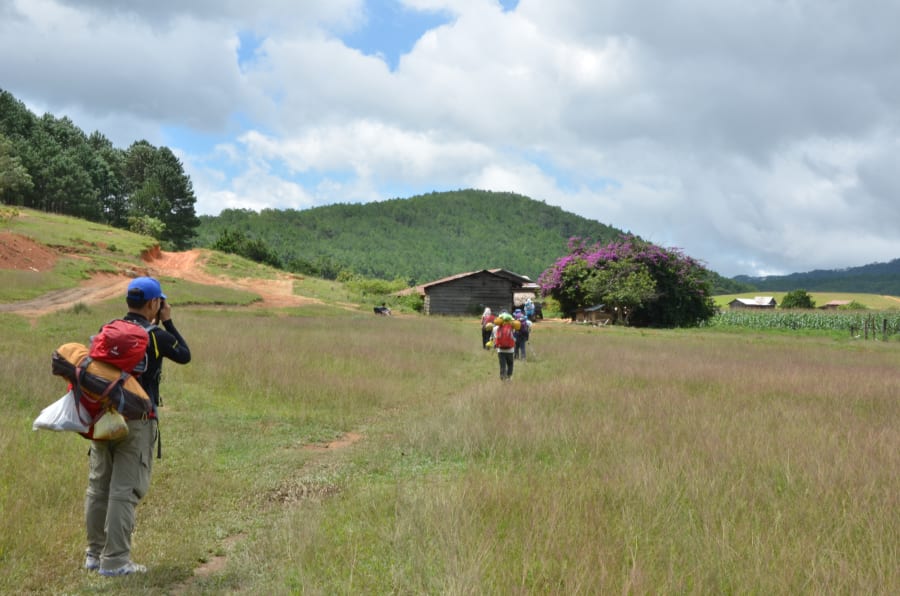
About 45 minutes in, we reached the first landmark: a small house with a vivid purple bougainvillea trellis, sitting in the middle of a vast green meadow. A few ethnic minority villagers watched us with curious eyes - back then, trekkers passing through were still a rare sight.
Maybe I was being dramatic. But standing there, I genuinely thought:
This is the last outpost of civilization before we walk into the wilderness behind it.
The Cursing Slope
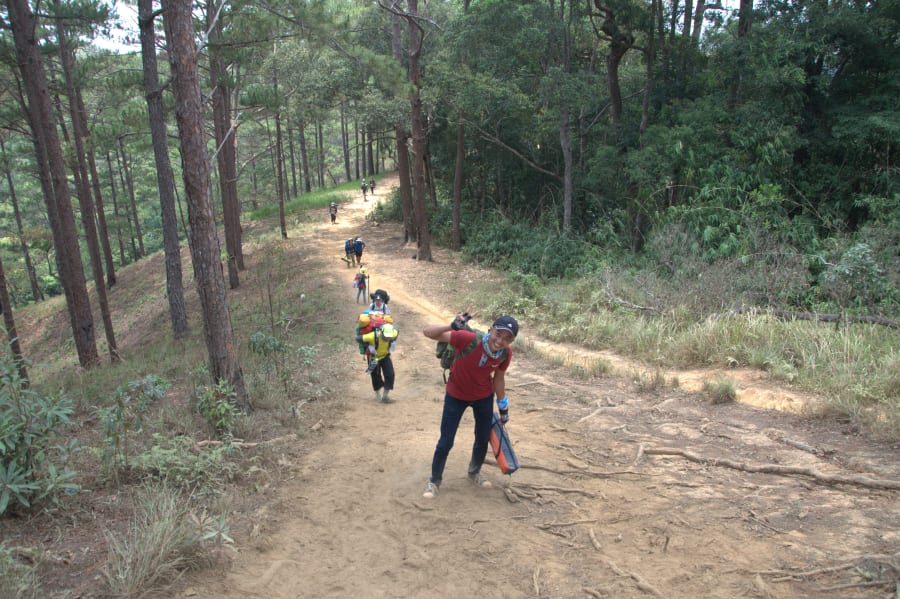
The flat trail suddenly gave way to a steep climb. Not a gentle incline - a long, near-45-degree ascent with no flat section to rest on.
It took me three outbursts to make it to the top. Looking back, almost everyone in the group did the same.
That's why locals call it Dốc Chửi Thề - the Cursing Slope. The name needs no further explanation.
The Grasslands - A Well-Earned Reward
Past the Cursing Slope and a few more climbs, we walked through a pine forest, crested one final hill - and the grasslands opened up in front of us.
A vast plateau of grass, stretching to the horizon in every direction.
There it is.
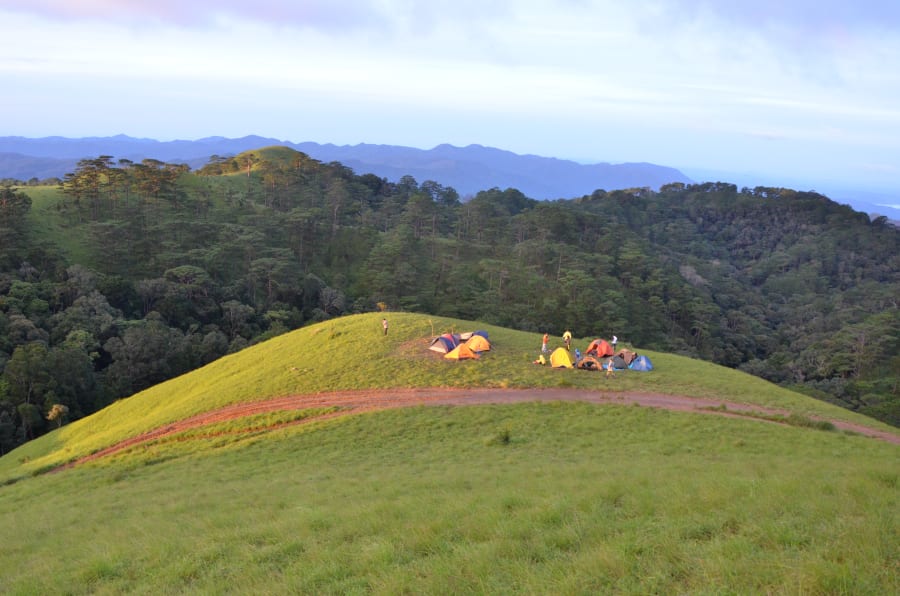
We hiked another 2 km to find a campsite - the top of a small hill with views all around. That night the wind was strong. On open hilltops with no tree cover, it always is. We drove tent stakes into all four corners to keep the shelter in place.
I also dug a small drainage trench around my tent in case of rain. Then slept soundly.
The Reckless Decision
That evening, with drinks flowing, the mood shifted. The original plan had been to turn back in the morning.
Instead, the group decided: if we've come this far, we go all the way. Straight down to Phan Dũng.
Simple enough in theory. But to put it in context: no GPS track, no guide, no idea of the route, no phone signal. Previous groups had said the descent takes three days. We were going to do it in one.
The bravado had taken hold.
And of course, things didn't go smoothly.
Getting Lost - First Time
The descent toward Phan Dũng got steeper. After a while, the trail simply disappeared.
We navigated by instinct and topographic map: heading east, following ridgelines, finding streams and walking downstream.
By 7 PM - still inside the forest. Right direction, but no way out yet.
Time to eat. Figure the rest out after.
Mid-meal, we heard motorbikes somewhere in the trees. Someone was about to shout for help. Another person stopped them:
"What if they're illegal loggers? What if they don't help - and decide to deal with us instead?"
Everyone switched off their headlamps and ate in silence.
At 9 PM, lights from a village appeared in the distance. Whatever exhaustion we'd been carrying disappeared in an instant. We practically ran toward the light.
I drank three cans of energy drink back to back.
End of the first time getting lost.
Second Trip - Brown Tà Năng (April 2016)
An Immediate Surprise
I came back in April, during the Hung Kings' Festival holiday. Same trail. Completely different world.
If the first trip was Green Tà Năng, this one I call Brown Tà Năng.
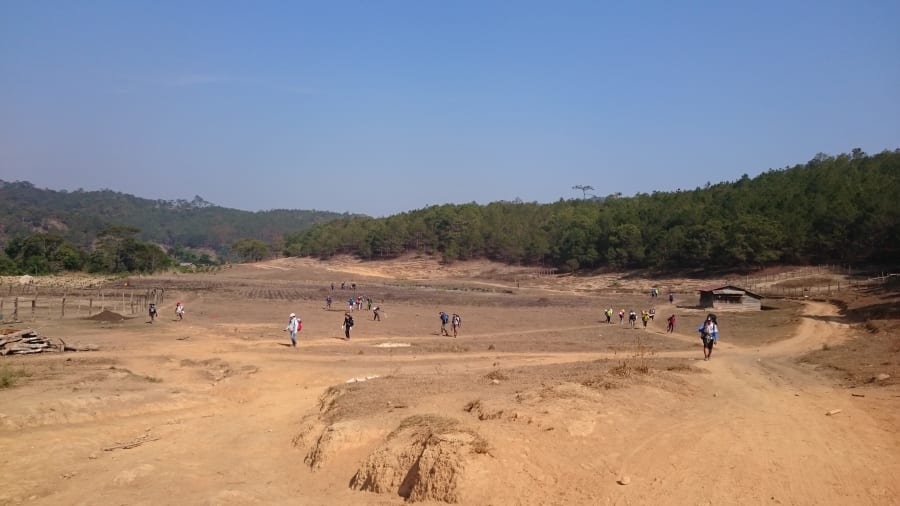
Same bougainvillea house - but instead of standing in a lush green meadow like something out of a fairy tale, it now sat bare and isolated on cracked, dry earth.
A little brutal. But honest.
25 Kilograms on Your Back
The biggest problem in dry season is water. We each carried 12 liters. Packs weighed around 25 kg.
The Cursing Slope lived up to its name again - arguably more so this time, in direct proportion to the heat and the weight on our backs.
The Trench I Dug for Myself
We camped at the same hillside as before. Wind still fierce. The tent next to mine had its frame buckled by a gust.
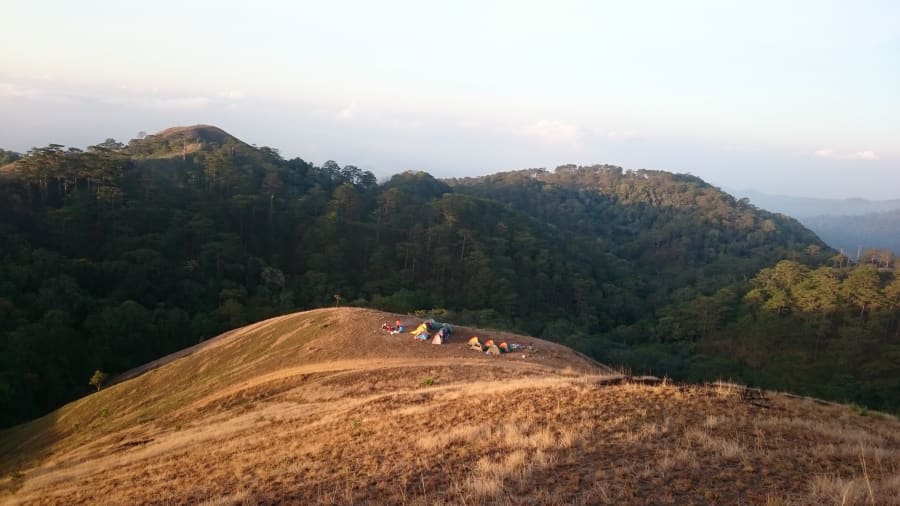
I couldn't sleep. A ridge in the ground was digging into my back all night. I spent the whole time cursing silently:
"Which idiot dug this trench here?"
The next morning, breaking camp, I looked more carefully.
The idiot was standing right there.
The drainage trench I'd dug myself a year earlier - to keep rainwater out - had spent the night working on my spine instead.
Took back the curse. Kept moving.
The Dry Season Forest
If Phan Dũng in the wet season is hard, the dry season is merciless. The heat isn't just warm - it's suffocating, trapped. The air was so dry it felt like a single spark could set the whole forest alight. Every step raised dust.
And we got lost again. This time, I was leading.
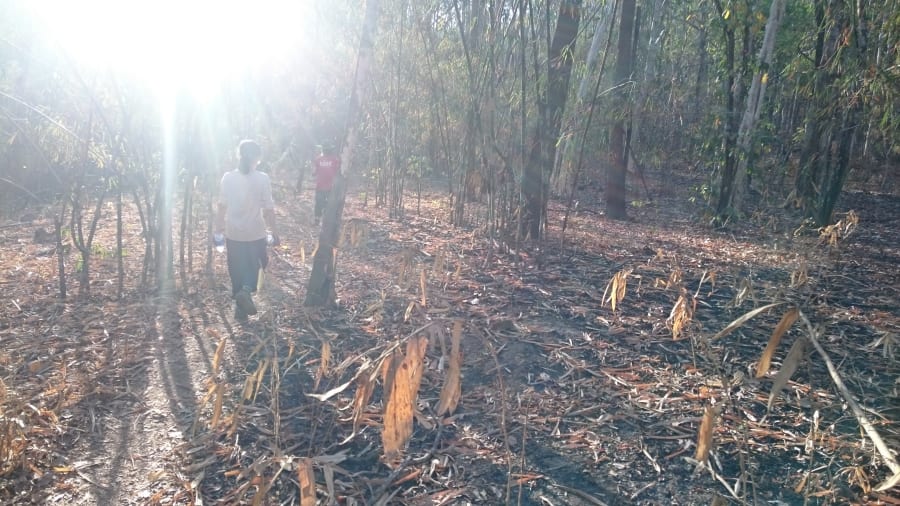
200 Meters in the Forest
Water was running low. The map showed a stream roughly 200 meters away as the crow flies. No trail to it.
I left my pack behind, took only a knife and my phone with the offline map, and pushed through the undergrowth to find it.
Found the stream. Turned back.
And immediately realized I was lost from my own group.
Just 200 meters. But every tree looked identical. Every direction looked the same. No landmarks, no trail, nothing to orient by.
That's when I understood what it actually means to get lost in a forest - you don't need to wander far. One moment of inattention is enough.
I shouted to locate the group. The distance was short enough that they heard me, shouted back, and we found each other.
An unwritten rule among Vietnamese forest trekkers: when you need to locate someone in the woods, call out with a shout or a holler - never use their name. The logic is simple and unsettling: if you call out a name, something in the forest now knows that name. And if it calls that name back - you might follow the voice deeper into the trees, thinking it's your group. Real people shout. They don't call your name.
Yavly Waterfall - The Fall That Saved the Trip
We made it down to the stream. Everyone ate lunch, refilled water. Tired. Quiet.
Then someone spotted a waterfall nearby, upstream.
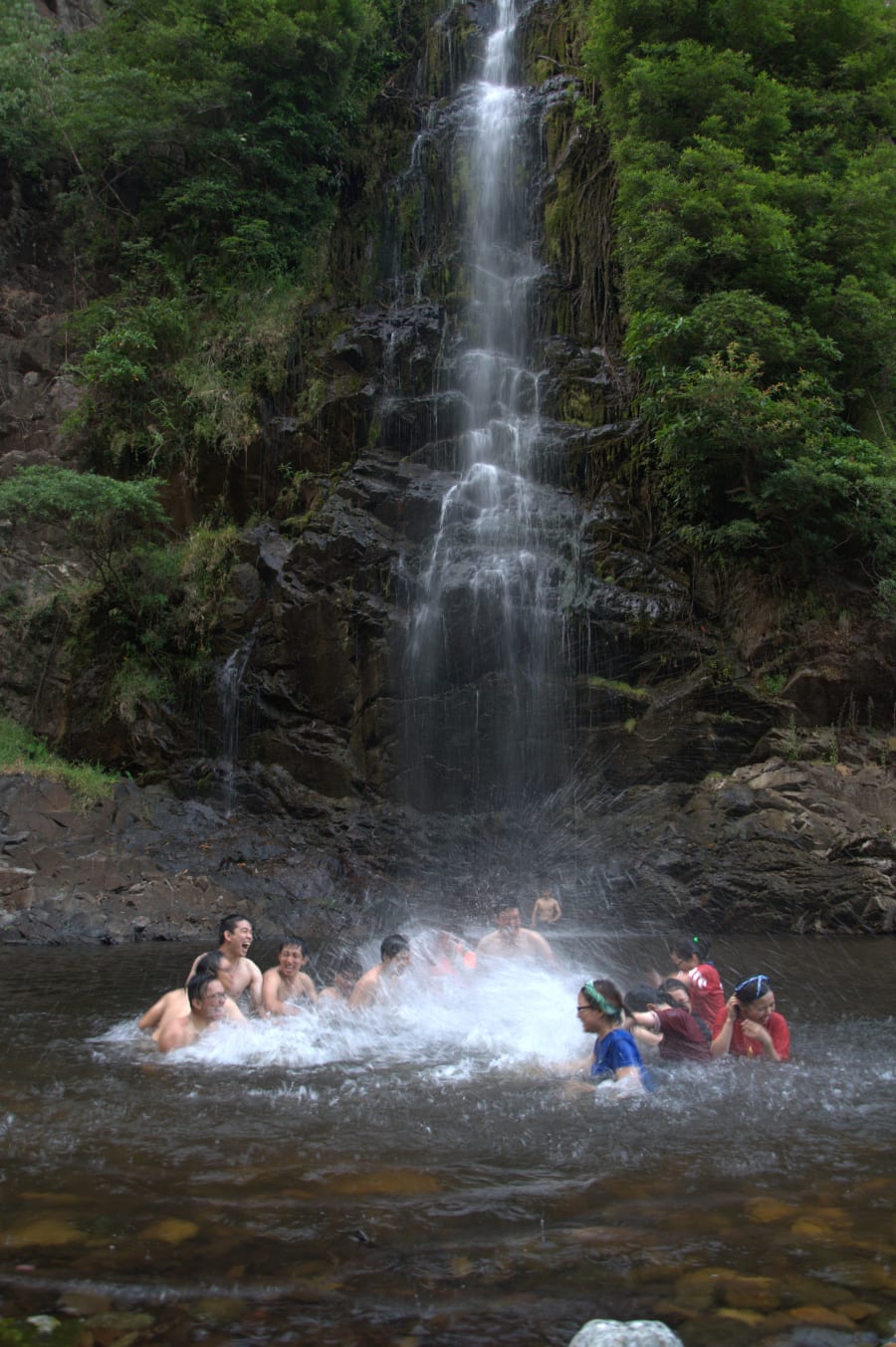
I still haven't forgotten what it felt like to see Yavly for the first time. Minutes earlier we'd been exhausted, dehydrated, disoriented in a burning dry forest. Then suddenly - cold rushing water, the sound of a waterfall, a clear pool at its base.
Nobody said anything. Everyone jumped in.
That waterfall didn't save us in any literal sense. But it saved the trip.
The End of the Road
From the falls, we followed the stream down and walked out into a village at the base of Phan Dũng.
That night, I looked up and the sky was full of stars.
Two Trips, One Trail
| August 2015 | April 2016 | |
|---|---|---|
| Season | Wet (green) | Dry (brown) |
| Water on trail | Plentiful | Scarce - 12L per person |
| The grasslands | Green, lush | Brown, exposed |
| Bougainvillea house | Fairy tale | Bare and dry |
| Got lost | Yes | Also yes |
| Who led us astray | The dark | Me |
| Saved by | Energy drinks | A waterfall |
Tà Năng – Phan Dũng Today
The trail is different now. GPS tracks exist. Guides know every turn. Two days and one night is the standard itinerary.
But in 2015 and 2016, it wasn't the terrain that made it hard - it was the absence of anyone who had mapped it properly before you. Every group had to find their own way, handle their own problems, and take full responsibility for what happened next.
That feeling of stepping into somewhere not yet fully discovered - it can't be recreated now.
And I feel lucky I walked it when I did.
Route Overview
Total: 2 days, 1 night (current standard). In 2015 we attempted it in one day - not recommended.
Next up: Read the full Tà Năng – Phan Dũng practical guide - best time to go, costs, what to pack, and why the dry season is harder than you think.